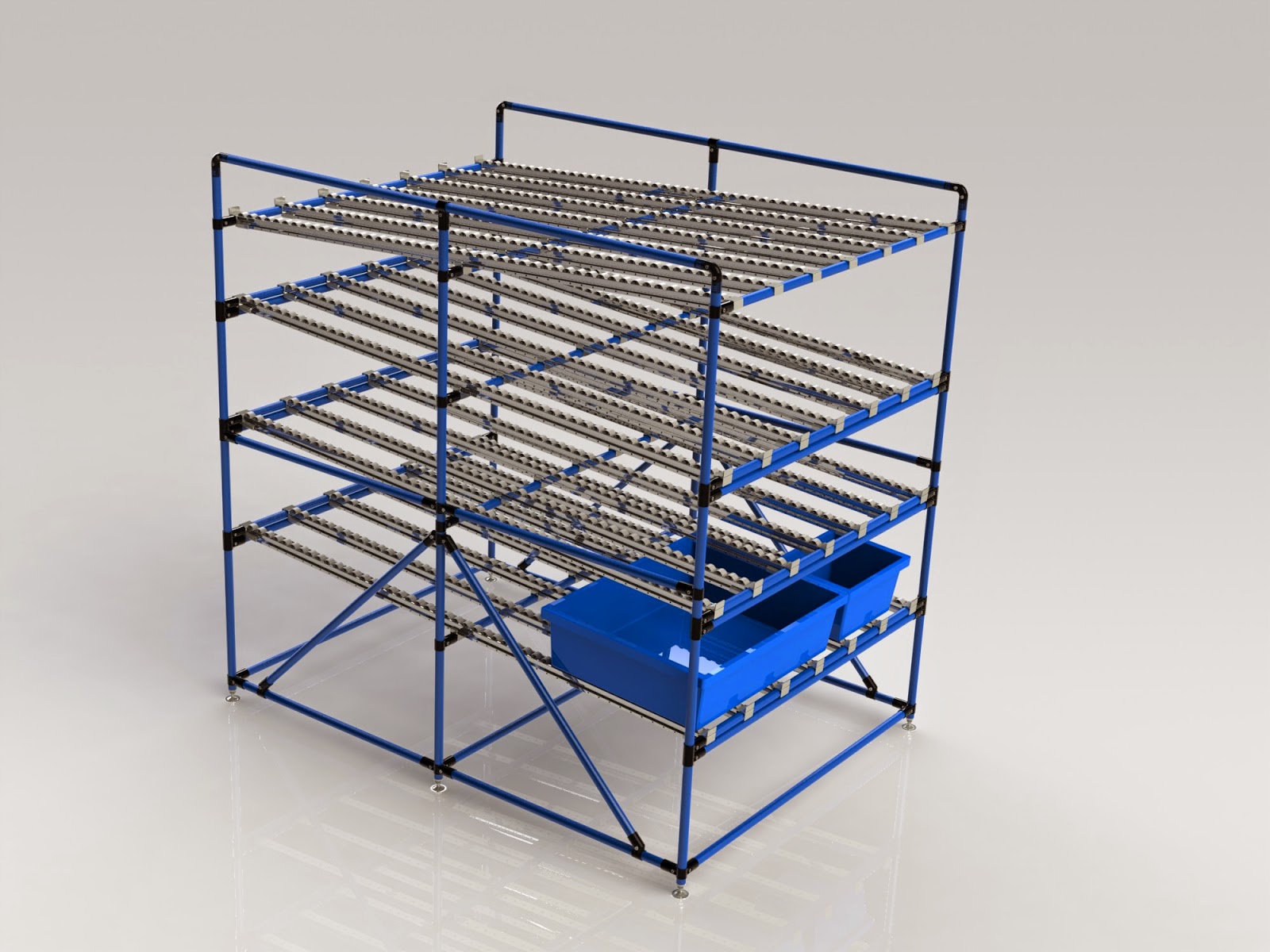
What to Know Before You Specify This Unit
A custom flow rack and kitting rack exists to enforce rotation — first in, first out — without anyone policing it. Load from the back, pick from the front, and the newest item physically cannot be picked first. Almost every failure of this design is a slope problem.
Points that decide whether it works on your floor
- Decide the replenishment interval and size the lane depth to it. A lane too shallow means hourly restocking; too deep and it becomes a storage rack that defeats rotation.
- Roller type should suit the container bottom. Smooth hard bottoms work on almost anything; soft or ribbed bottoms need more aggressive rollers.
- Side guides are not optional for mixed carton sizes — without them anything narrow turns sideways and jams the lane.
- Boxes matter more than the rack. A scuffed or soft base will not slide consistently regardless of how good the rail is.
- Leave room above the lane for lifting cartons out vertically. Operators should not have to tilt a full box out of a tight opening.
- Plan replenishment access from the rear aisle before installation. Racks sited against a wall make every restock a front-of-house operation.
Frequently Asked Questions
How many lanes do we need?
One lane per SKU in the pick face. The practical error is building too few lanes and spending years shuffling stock between them.
Will it work with our existing cartons?
Base condition decides. Flat, rigid bases flow well; soft, scuffed or bulged bases stall unpredictably. Send carton dimensions and the flow rack can be matched to them.
What slope should a custom flow rack and kitting rack be set to?
Enough that cartons travel the full lane steadily, and no more. Reality depends heavily on carton weight and base condition, so it is set during commissioning rather than calculated once — build in adjustability.