What to Know Before You Order
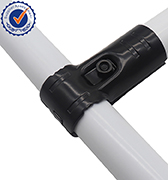
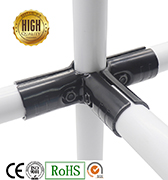
YSL-2 45-Degree Aluminum Corner Joint belongs to the family of cast and pressed fittings that hold a 28 mm tube frame together. Individually it is a small casting with one bolt; collectively these parts decide whether a workstation behaves as one rigid structure or as a set of tubes leaning against each other.
Points that decide whether it works
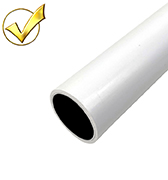
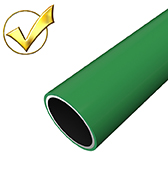
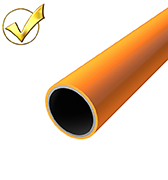
- Confirm the pipe you are joining: 28 mm OD is the standard, but wall thickness changes how much clamping travel the joint has. Thin-wall and thick-wall tube are not always interchangeable in the same fitting.
- Where the frame will be rebuilt, check that the joint is rated for multiple assembly cycles. Clamping force that fades after the second build turns a modular system into a consumable one.
- Surface finish is a corrosion decision. Zinc plating covers general workshop conditions; chromed or electrophoresed finishes are for visible frames and light washdown; stainless is for humidity, washdown and coastal freight.
- Specified torque for an M6 bolt in this family is typically 8 to 10 Nm. Two fitters working by feel will differ by up to a factor of two, and the frame that holds its rating is the one assembled with a wrench rather than a hex key and good intentions.
- Joint halves are tightened to clamp, not to pin. The structure holds because friction between the coating and the casting exceeds the load trying to rotate the tube — which makes bolt torque a structural specification, not a preference.
Frequently Asked Questions
Do you supply an ESD version?
Yes. The dissipative version is specified where the workstation is grounded, and it needs to be ordered explicitly rather than assumed — mixing standard and dissipative joints in one frame breaks the path.
What torque should I use?
Typically 8 to 10 Nm for an M6 bolt in this family, then again after 24 to 48 hours once the coating has settled. Use a wrench, not feel; the difference between two fitters is larger than most people believe.
How much load can this joint carry?
The joint is rarely the first thing to fail — the tube span usually gives way first, by sagging rather than breaking. What limits a frame is joint stiffness under sideways load, which is why torque and retorquing matter more than the catalogue weight figure.